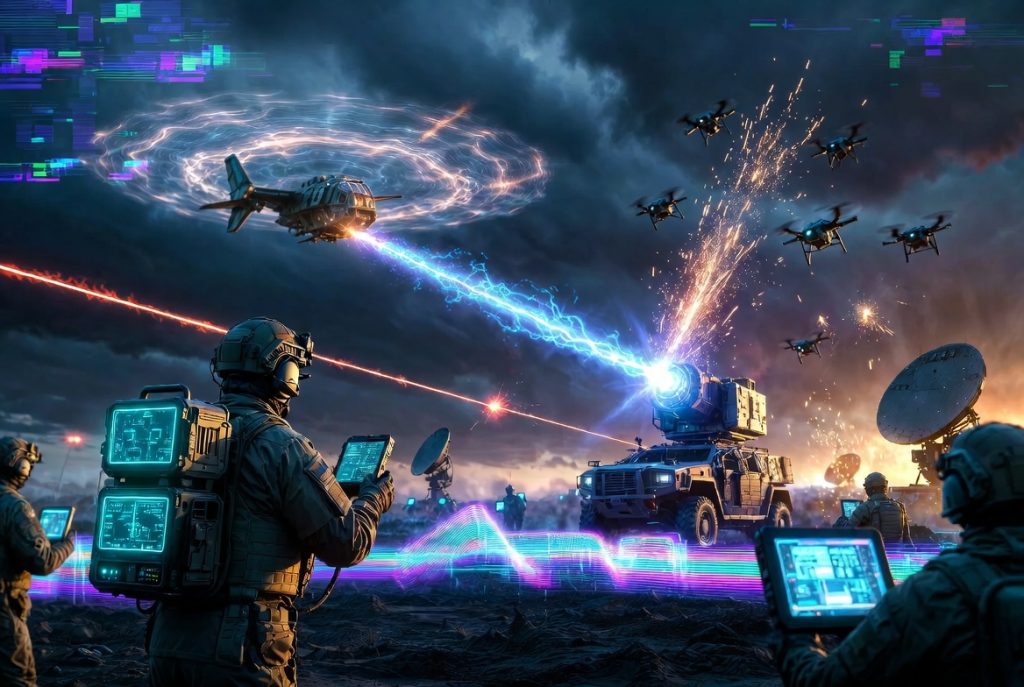
Electronic Warfare (EW), often called Electromagnetic Warfare, is the silent, invisible battlefield of the modern era. It involves using the electromagnetic spectrum (EMS) — radio waves, microwaves, infrared, and directed energy — to detect, disrupt, protect, or attack an adversary’s electronic systems without traditional kinetic weapons.
In 2026, EW has evolved into a critical multi-domain capability. Conflicts in Ukraine, the Middle East, and potential great-power scenarios show that controlling the EMS can decide outcomes faster and with less collateral damage than bullets or missiles. Drones, radars, communications, GPS, and even AI-driven systems all depend on electricity and electronics — making EW a high-stakes “electric” contest.
From portable soldier-carried jammers to airborne platforms and directed-energy weapons, here’s how electric-powered tools and machines dominate new-age electronic warfare.
What Is Electronic Warfare? The Three Pillars
EW is divided into three core subdivisions:
- Electronic Attack (EA) — Offensive actions: jamming enemy radars and communications, deceiving sensors with false signals, or using directed energy to disable electronics.
- Electronic Protection (EP) — Defensive measures: shielding friendly systems from jamming, spoofing, or electromagnetic interference.
- Electronic Support (ES) — Intelligence gathering: detecting, identifying, and locating enemy emitters (radars, radios, drones) for targeting or avoidance.
In 2026, these pillars integrate with cyber operations, AI, and autonomous systems under the broader umbrella of Electromagnetic Spectrum Operations (EMSO).
Key Tools and Machines in New-Age Electronic Warfare (2026)
Modern EW systems are increasingly electric and battery-powered for portability, or vehicle/aircraft-mounted with high-power electrical generation.
1. Portable and Manpack EW Systems (Trench EW)
- Lightweight backpack or soldier-worn devices (e.g., systems under 10 kg with 1–2 hours battery life).
- Examples: Ukrainian VIK-2K or similar anti-drone jammers targeting 2.4 GHz and 5.8 GHz frequencies used by commercial drones like DJI Mavic.
- Capabilities: Jam drone control links, GPS spoofing, or disrupt communications within hundreds of meters.
- Electric advantage: Rechargeable via portable power stations or vehicle inverters — ideal for prolonged operations without fuel logistics.
2. Vehicle-Mounted and Modular EW Kits
- The U.S. Army is prototyping modular EW kits in 2026 that can mount on almost any platform (trucks, robots, drones).
- Systems like the Terrestrial Layer System (TLS) or Individual CORVUS Node (ICN) — compact, software-defined radios covering 20 MHz to 6 GHz.
- Functions: Counter-IED, counter-small UAS (unmanned aerial systems), signals intelligence (SIGINT), and electronic attack.
- Many integrate with existing military vehicle electrical systems or high-capacity batteries.
3. Airborne Electronic Warfare Platforms
- New programs in 2026: U.S. Army seeking a new airborne jammer as a spin-off from previous Multi-Function Electronic Warfare (MFEW) efforts.
- Platforms like the EA-18G Growler (U.S. Navy), EA-37B Compass Call, or modified business jets with advanced jamming pods.
- Next-Generation Jammer (NGJ) systems deliver high-power RF energy to overwhelm enemy radars over long distances.
- Power demands: These require robust onboard electrical generation and cooling systems — highlighting the role of advanced power electronics.
4. Directed Energy Weapons (DEW) — The “Electric” Future of Attack
- High-Energy Lasers (HEL) and High-Power Microwaves (HPM) convert electrical power directly into focused energy beams.
- Applications:
- Burn through drone airframes or optics (lasers).
- Fry electronic circuits in drone swarms with a single pulse (microwaves) — leaving structures intact, perfect for urban or base defense.
- Examples: U.S. and allied tests of microwave systems disabling dozens of drones simultaneously; Indian HPM prototypes targeting quadcopters up to 5 km.
- Why electric? DEWs offer “unlimited magazine” — as long as power is available (via generators, batteries, or vehicle systems), shots cost pennies compared to missiles.
- Counter-drone DEWs are rapidly maturing for protecting air bases, convoys, and forward positions.
5. AI-Enabled and Cognitive EW Systems
- Machine learning for rapid signal detection, classification, and adaptive jamming.
- Cognitive EW tools analyze dense RF environments in real time, automatically selecting the best countermeasures against evolving threats (e.g., frequency-hopping radars or new drone protocols).
- Edge-deployed AI on portable devices allows soldiers to react faster than traditional systems.
6. Counter-Drone and Anti-UAS Systems
- RF jammers, GPS spoofers, and DEW integrated into layered defenses.
- Portable “anti-drone rifles” that emit electromagnetic pulses to sever control links.
- Many run on rechargeable battery packs, making them deployable anywhere.
Why Electric Power Is Central to New-Age EW
- Portability and Autonomy: Cordless/battery-powered systems reduce logistical burdens (no constant fuel resupply). High-capacity batteries and portable power stations enable rapid deployment in contested areas.
- Efficiency and Speed: Brushless motors, advanced power electronics, and software-defined radios allow quick reconfiguration without hardware swaps.
- Low Signature: Many modern EW tools emit only when needed (“once you emit, you become a target”), and electric systems can be more precisely controlled.
- Integration with Civilian Tech: Commercial-off-the-shelf (COTS) components, solar-compatible chargers, and power management tools (similar to those in professional power tools) make EW more accessible and scalable.
- Sustainability in Prolonged Conflicts: In energy-constrained crises, electric EW solutions pair well with generators, solar arrays, and vehicle power take-offs.
Compared to traditional kinetic weapons, EW offers non-lethal or low-collateral options, preserving ammunition for critical strikes.
Challenges and Trends in 2026
- Spectrum Congestion: Dense urban or multi-domain battlespaces require smarter, AI-driven spectrum management.
- Miniaturization: Smaller, lighter systems for infantry, drones, and unmanned ground vehicles.
- Open Architectures: Modular, upgradable hardware/software to counter fast-evolving threats.
- Counter-EW: Adversaries develop their own protections, leading to an ongoing arms race in electronic protection.
- Market Growth: The global EW systems market is expanding rapidly (projected multi-billion dollar valuations with steady CAGR), driven by drone proliferation and great-power competition.
The U.S. Army, in particular, is revamping acquisition in 2026 for faster fielding of EW and SIGINT capabilities through broader industry requests.
Real-World Impact and Preparedness
In recent conflicts, EW has neutralized drone swarms, blinded radars, and disrupted command networks — often deciding tactical engagements. For militaries, contractors, and even preparedness-minded civilians, understanding EW highlights the importance of robust electrical infrastructure: reliable batteries, inverters, surge protection, and power tools for maintaining equipment in the field.
On ElectricCounselor.com, we see parallels in how cordless power tools (impact wrenches for repairs, angle grinders for fabrication) and portable power solutions support both everyday work and crisis response — including potential EW-adjacent scenarios like emergency communications or infrastructure repair after disruptions.
Final Thoughts: The Electric Edge in Modern Warfare
In the new age of warfare, victory increasingly goes to those who master electricity and the electromagnetic spectrum. Tools range from backpack jammers and AI-driven sensors to high-power microwave weapons and modular airborne systems. Electric-powered solutions provide the mobility, endurance, and precision needed in dynamic battlespaces.
As technology advances in 2026, expect even tighter integration between EW, autonomy, and high-energy electrical systems. Staying informed about these developments helps appreciate the critical role of reliable power — whether on the battlefield or in your workshop.
Related Reads on ElectricCounselor.com:
- Why Electric Products Are Useful in Crisis Moments
- Corded vs Cordless Angle Grinder: Which Wins in Emergencies?
- Impact Wrench Buying Guide
- Portable Power Stations for Off-Grid and Emergency Use
What aspect of electronic warfare interests you most — counter-drone tech, directed energy, or power requirements for field systems? Share in the comments, and we can dive deeper or recommend related electrical tools for preparedness.