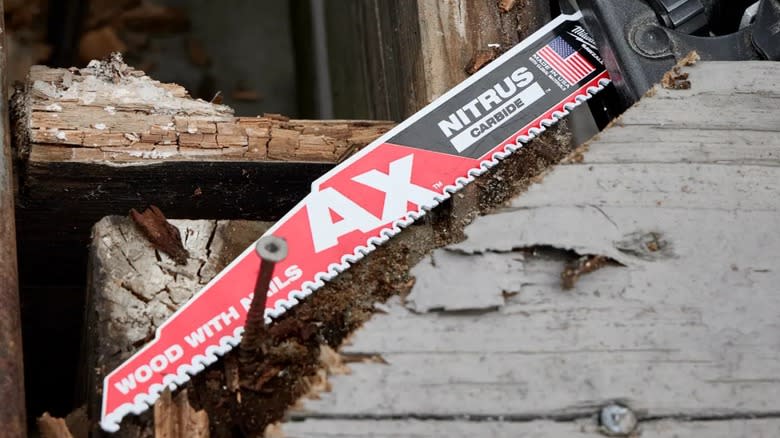
When it comes to heavy-duty wood demolition, Milwaukee’s ‘Ax’ Sawzall blades have long been a gold standard. For 2026, the lineup has reached its peak with the Nitrus Carbide upgrade. To find out if this premium blade justifies its higher price tag, we sat down with Joe Stehlik, Milwaukee’s Product Manager, to break down the tech and the real-world value.
What Does “Nitrus” Actually Mean?
In the Milwaukee ecosystem, the “Nitrus” label is reserved for their absolute best. Just as a race car uses nitrous oxide for supercharged performance, Milwaukee’s Nitrus accessories are engineered to push the limits of their M18 Fuel power tools. It isn’t just a marketing buzzword; it represents the highest tier of tooth durability and cutting speed.
Key Design Shift: Tooth Geometry
The primary enemy of a wood-cutting blade is the “hard strike”—slamming into a nail or screw while moving at over 3,000 strokes per minute.
- Standard Carbide: Typically engages the material at a 90° angle. While strong, repeated impacts eventually chip or round over the teeth.
- Nitrus Carbide: Features a much sharper attack angle. Instead of “slamming” into metal fasteners, it slices into them. This preservation of tooth geometry significantly extends the life of the carbide tips.
Double the Life
According to Milwaukee’s internal testing, the Nitrus Carbide Ax lasts roughly twice as long as the standard Carbide Ax when cutting through hardened materials like masonry nails or structural screws.
The Math: If a standard Carbide Ax survives 140 deck screws, you can expect the Nitrus Carbide version to power through roughly 280 before calling it quits.
Choosing the Right Blade for the Job
You could use Nitrus for everything, but you don’t need to. Choosing the right blade balances performance with your budget:
| Blade Type | Recommended Applications |
| Bi-Metal Ax | Standard framing nails, roofing nails, staples. |
| Carbide Ax | Galvanized nails, drywall screws, self-tapping screws. |
| Nitrus Carbide Ax | Deck screws, structural screws, Tapcons, masonry nails. |
Is the Premium Price Worth It?
While the upfront cost of a Nitrus blade is higher, the “cost per cut” tells a different story. Let’s look at the average price for a 9-inch blade:
- 1 Nitrus Carbide Ax ($16.99)
- 2 Carbide Ax Blades ($21.98)
- 20 Bi-Metal Ax Blades ($86.00)
Even though you pay more at the counter, the Nitrus blade replaces twenty bi-metal blades, saving you nearly $70 in the long run.
Cost Per Cut Breakdown:
When cutting through wood embedded with masonry nails:
- Carbide Ax: ~$0.37 per cut.
- Nitrus Carbide Ax: ~$0.31 per cut.
On a large-scale demolition project involving 10,000 cuts, switching to Nitrus Carbide could save a crew over $500 in accessory costs alone, not to mention the time saved by changing blades less frequently.
The Bottom Line
The Milwaukee Nitrus Carbide Ax isn’t just a luxury—it’s a strategic tool. If your demo work involves basic framing, stick with bi-metal. But if you’re tearing down decks or working with hardened fasteners, the Nitrus Carbide Ax is both the most productive and the most cost-effective choice you can make.