
The landscape of modern warfare has been fundamentally reshaped by the advent of loitering munitions, commonly known as “kamikaze drones.” These systems combine the reconnaissance capabilities of a surveillance drone with the precision strike of a missile, loitering over an area before diving into a target. As this technology proliferates, distinct design philosophies have emerged among the world’s leading military powers. This article provides an in-depth comparison of four key players: Iran’s Shahed-136, the American Switchblade 300/600 and LUCAS, and China’s emerging family of loitering munitions, exploring their design, capabilities, and strategic roles.
Iran’s Shahed-136: The Affordable Weapon of Attrition
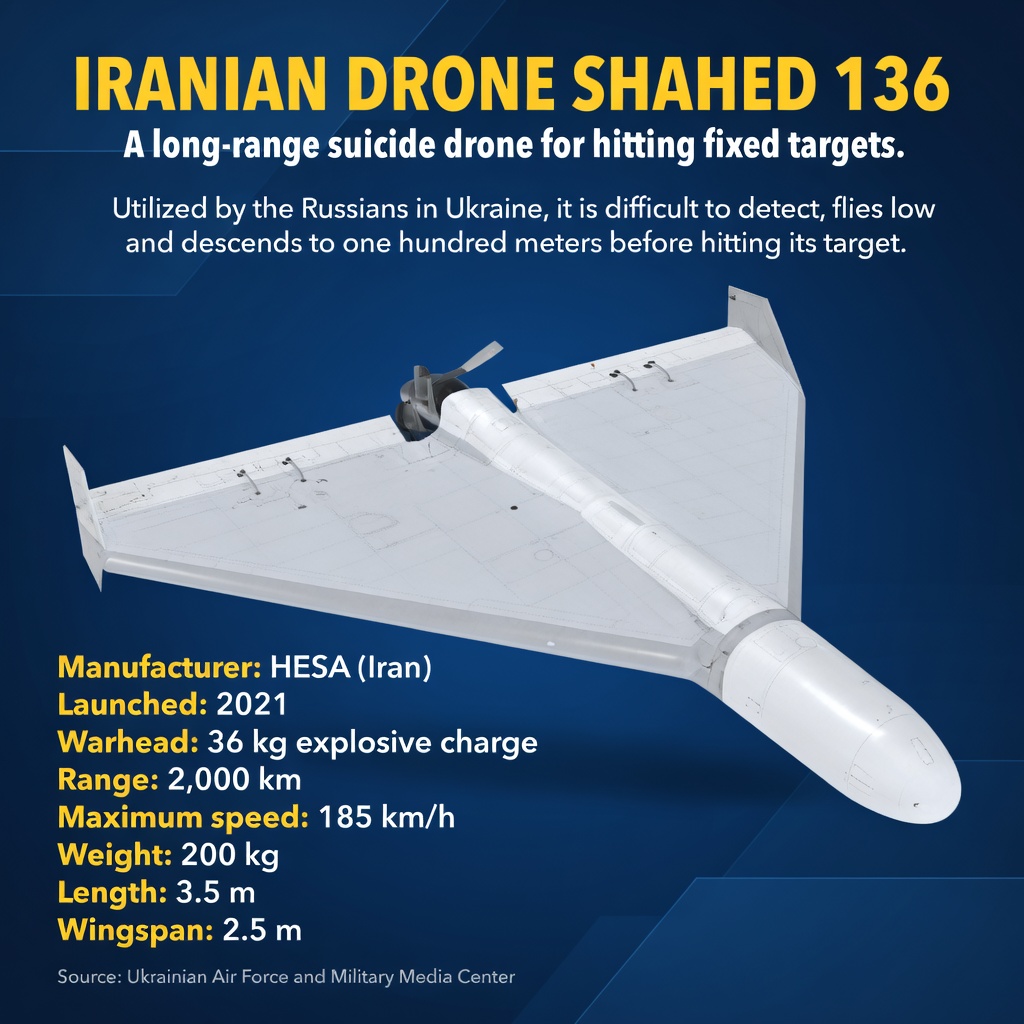
The HESA Shahed-136, often referred to by its Russian designation Geran-2, has become a symbol of a new kind of warfare. Its primary characteristic is not speed or stealth, but overwhelming affordability .
Design and Philosophy: The Shahed-136 is a delta-winged drone with a blunt-nosed fuselage, designed for simplicity and mass production. It is propelled by a rear-mounted piston engine, giving it a distinctive, low-frequency sound that has earned it the nickname “flying moped” in Ukraine . This design prioritizes cost and range over sophistication.
Technical Specifications:
- Range: Impressive long-range capability, estimated between 1,000 to 2,500 kilometers .
- Speed: Cruising speed of approximately 185 km/h .
- Warhead: Carries a substantial high-explosive fragmentation warhead of 30-50 kilograms .
- Guidance: Primarily relies on pre-programmed GPS and inertial navigation systems (INS), making it effective against fixed, soft targets but vulnerable to jamming .
Tactical Use and Evolution: The Shahed-136 is a weapon of strategic attrition. Launched in swarms from truck-mounted platforms, its goal is to saturate and exhaust enemy air defenses, which are forced to use expensive interceptors against low-cost drones . Recent developments, however, show Iran is actively addressing its limitations. A new jet-powered variant has been observed, featuring an optical sensor for terminal guidance. This allows for real-time targeting and locks out jamming attempts, significantly increasing its effectiveness against point targets . Furthermore, an upgraded version supplied to Russia now includes a thermal imaging camera and an Nvidia Jetson Orin minicomputer, enabling autonomous target recognition and improved resistance to electronic warfare . This evolution from a “blind” munition to a more intelligent system marks a significant leap in its lethality.
United States: Two Philosophies for Different Battlefields
The United States fields a diverse array of loitering munitions, ranging from the man-portable Switchblade to the Shahed-inspired LUCAS, reflecting a doctrine that requires both tactical precision and strategic reach.
Switchblade 300 & 600: The Precision Scalpel
The AeroVironment Switchblade series represents the high-precision, low-collateral-damage end of the spectrum. Designed for infantry units, it is a tube-launched system that fits into a backpack .
Design and Philosophy: The Switchblade’s name comes from its wings, which spring open after launch. It is a true “loitering” munition, providing the operator with real-time video feeds to identify, track, and engage targets with a human-in-the-loop . A key feature is the “wave-off” function, allowing the operator to abort a strike at the last second if the situation changes .
Technical Specifications:
| Feature | Switchblade 300 | Switchblade 600 |
|---|---|---|
| Primary Role | Anti-personnel, light armor | Anti-armor, hardened targets |
| Range | 10 km | 40 km (90+ km objective) |
| Endurance | 15 minutes | 40+ minutes |
| Weight | 2.5 kg (system) | 54.4 kg (system) / 22.7 kg (missile) |
| Warhead | Equivalent to 40mm grenade | Anti-armor, Javelin-class tandem charge |
| Guidance | EO/IR camera, GPS | EO/IR camera, GPS |
Tactical Use: The Switchblade 300 is a precision tool for engaging point targets like enemy combatants or light vehicles with minimal risk to civilians . The larger Switchblade 600, with its anti-tank warhead, provides company-level units with a precision-strike capability against main battle tanks, offering a longer-range and lower-cost alternative to traditional Javelin missiles .
LUCAS: The American Shahed
The Low-cost Unmanned Combat Attack System (LUCAS) marks a radical departure for the U.S. military, representing an explicit acknowledgment of the effectiveness of Iran’s drone warfare strategy .
Design and Philosophy: LUCAS is, in essence, a reverse-engineered Shahed-136. It shares the same delta-wing design, pusher propeller, and twin-boom tail, but is fitted with modern U.S. avionics, a more reliable engine, and advanced AI capabilities . Its purpose is to provide the U.S. with a low-cost, attritable asset that can be deployed in large numbers, effectively “flipping the script” on adversaries who pioneered this tactic .
Technical Specifications:
- Cost: Approximately $35,000 per unit, making it a truly expendable asset .
- Range: Estimated to be up to 2,500 kilometers, mirroring the Shahed’s strategic reach .
- Modularity: Unlike the base Shahed model, LUCAS features interchangeable nose cones, allowing it to carry either an explosive warhead for strike missions or a sensor payload for intelligence, surveillance, and reconnaissance (ISR) .
- Autonomy: Equipped with AI for coordinated swarm operations, allowing dozens of LUCAS drones to share targeting data and conduct complex missions .
Tactical Use: LUCAS is designed for Suppression of Enemy Air Defenses (SEAD), deep strikes against high-value targets, and creating dilemmas for adversaries. Its low cost and AI-enabled swarming capability allow U.S. forces to threaten saturation attacks that would be prohibitively expensive with manned aircraft or cruise missiles .
China: A Focus on Combined-Arms and Swarm Tactics
China’s approach to loitering munitions is diverse, focusing on integration with ground forces and developing systems for both tactical and strategic roles. While information on some systems is limited, two distinct categories have emerged: man-portable infantry munitions and larger, more capable systems like the ZD family and the anti-radiation ASN-301.
The Man-Portable System: An Infantryman’s Precision Firepower
China has developed a class of loitering munitions designed for individual soldiers, emphasizing portability and anti-armor capability.
Design and Philosophy: This system is built around the concept of the “squadron as a battery.” A single soldier can carry a backpack containing four of these tube-launched drones, enabling a small unit to deploy a devastating swarm of precision-guided munitions .
Technical Specifications:
- Weight: Just 1.8 kg per drone, allowing for individual portability .
- Warhead: Carries 500g of TNT, which is claimed to have the destructive power of an 82mm mortar shell, capable of destroying an armored vehicle with a direct hit .
- Endurance: 30 minutes of flight time .
Tactical Use: This drone is a force multiplier for light infantry. In a theoretical engagement, a nine-soldier squad could deploy 36 drones, swarming and overwhelming an entire armored company. This exemplifies China’s focus on asymmetric warfare, using low-cost, high-tech solutions to counter expensive heavy armor .
The ZD Family and ASN-301: Versatility and Specialization
For longer-range and specialized missions, China fields systems like the ZD family and the ASN-301.
Design and Philosophy: The ZD family (ZD70, ZD90, ZD180) represents a modular approach, with tube-launched drones of increasing size designed for different payloads and missions. They can be used for reconnaissance or as loitering munitions . The ASN-301 is a dedicated anti-radiation loitering munition, designed specifically to home in on and destroy enemy radar emissions, a critical component of Suppression of Enemy Air Defenses (SEAD) .
Technical Specifications:
- ZD90: Maximum take-off weight (MTOW) of 10 kg, a 2.5 kg payload, and a 40-minute endurance . Its guidance includes both Chinese BeiDou and Western GPS signals .
- ASN-301: Designed for rapid, large-scale suppression of air defenses, often showcased in swarm configurations to overwhelm enemy radar networks .
Tactical Use: The ZD family provides ground commanders with flexible, organic fire support and reconnaissance at ranges out to 50 km . The ASN-301 is a key enabler for gaining air superiority, clearing a path for manned and unmanned aircraft by eliminating ground-based radar threats with swarm precision .
Comparative Analysis: A Clash of Doctrines
| Feature | Iran Shahed-136 | USA LUCAS | USA Switchblade 600 | China Man-Portable |
|---|---|---|---|---|
| Strategic Role | Strategic Attrition | Strategic Swarm/SEAD | Tactical Anti-Armor | Tactical Squad Support |
| Range | 1,000 – 2,500 km | ~2,500 km | 40+ km | ~10-50 km (est.) |
| Warhead | 30-50 kg HE-Frag | Modular (HE/ISR) | Anti-Armor (Javelin-class) | 0.5 kg HE (Anti-Armor) |
| Guidance | GPS/INS, evolving to EO/AI | GPS/INS, AI Swarm | EO/IR, GPS, Human-in-the-Loop | GPS/BeiDou, EO |
| Unit Cost | $20,000 – $50,000 | ~$35,000 | ~$100,000+ (est.) | Low (mass-produced) |
The comparison reveals distinct national doctrines. Iran’s Shahed-136 is a weapon of strategic cost-imposition. Its primary goal is to force an enemy to expend vast resources defending against a flood of cheap, long-range munitions. Its recent upgrades for precision suggest a desire to combine this attritional effect with the ability to strike more valuable, protected assets .
The United States demonstrates a bifurcated approach. The Switchblade series is a precision instrument, reflecting a doctrine that values minimizing collateral damage and maintaining tight control over the battlespace . It is a tool for the tactical commander. In contrast, LUCAS is a strategic weapon that adopts the enemy’s own playbook. It acknowledges that in a conflict against a peer adversary, the U.S. must also have the ability to conduct cheap, massed, long-range strikes without risking pilots .
China’s developments appear focused on integration and combined-arms warfare at multiple levels. The man-portable system provides the infantryman with unprecedented organic firepower to defeat armor, blurring the line between the rifle squad and the artillery battery . Systems like the ZD family and ASN-301 are designed for coordinated, multi-domain operations, using swarms to perform specialized tasks like SEAD to support the broader air and ground campaign .
Conclusion
The era of the cheap, unmanned, one-way attack drone is firmly established. The Iranian Shahed-136 has proven that even a relatively unsophisticated design can have an outsized strategic impact through sheer numbers. The American response, with both the surgical precision of the Switchblade and the mass-attack capability of the LUCAS, shows a military adapting to a new reality where expensive, multi-role platforms are no longer the only option. Meanwhile, China is weaving loitering munitions into the very fabric of its ground forces, from the individual soldier to the corps commander, creating a future battlefield where threats can emerge from any point, at any time, in overwhelming numbers. The future of conflict will be defined not just by the most advanced technology, but by the most effective and adaptable synthesis of cost, numbers, and intelligence.