You’ve seen the flashy ads: 1,400 ft-lbs of “nut-busting” torque. The big, burly cordless impact wrench that looks like it could remove the lug nuts off a semi-truck. So you buy it, thinking bigger is always better. Then you spend an hour wrestling the beast in a tight wheel well, your wrists are screaming, and you shear a stud on your daily driver because you didn’t ease into it. Sound familiar?
For automotive DIYers and mobile mechanics, choosing between a mid-torque and high-torque cordless impact wrench is one of the most common (and expensive) decisions. This isn’t about brand loyalty—Milwaukee, DeWalt, Makita, Flex, or whatever platform you’re on. It’s about matching the tool to the job so you don’t end up with a garage paperweight or a snapped bolt.
Let’s break it down realistically: specs, real-world use, weight and clearance, the marketing myths around torque numbers, and a practical rule of thumb that’ll save your money, wrists, and fasteners.
Understanding the Categories
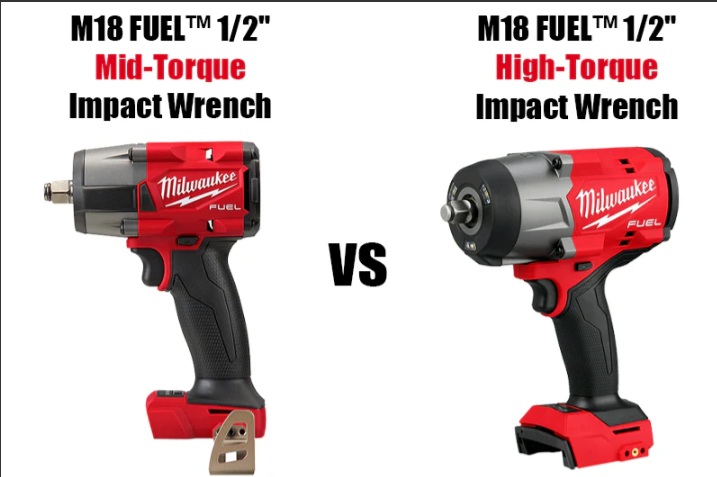
Mid-Torque Impact Wrenches (typically 400–700 ft-lbs nut-busting / 300–550 ft-lbs fastening/working torque):
- Compact and lightweight (often 5–6 lbs with a decent battery).
- Great balance of power and usability.
- Examples: Milwaukee M18 Fuel Mid-Torque (around 600 ft-lbs nut-busting), DeWalt mid-range models, Makita equivalents.
High-Torque Impact Wrenches (1,000–1,500+ ft-lbs nut-busting):
- Beast mode for serious stuck fasteners.
- Heavier and bulkier (7–9+ lbs), longer anvil/head.
- Examples: Milwaukee High Torque (1,400+ ft-lbs), top DeWalt or Ingersoll Rand models.
The key difference isn’t just raw power—it’s physics and ergonomics. Higher torque usually requires a bigger hammer mechanism, more robust internals, and often a larger battery draw, which translates to more weight and size.
Weight and Clearance: The Real Shop Difference
This is where high-torque tools often disappoint in daily automotive work.
- Wheel changes and brakes: Mid-torque shines here. It slips easily between suspension components, control arms, and fender wells. You can hold it comfortably overhead or at awkward angles for hours without fatigue. Many users report their mid-torque feels like a 3/8″ driver in the hand but punches like an old 1/2″ air tool.
- Suspension, axle nuts, or heavy equipment: High-torque earns its keep. Trying to remove a seized 200+ ft-lb control arm bolt or tractor tire lugs with a mid-torque can lead to frustration, stripped sockets, or dead batteries. The extra mass and power help deliver those hammer blows effectively.
Real talk from mechanics: The high-torque gun often sits in the truck “just in case,” while the mid-torque (or even a compact stubby) does 80-90% of the work. Holding a heavy high-torque tool in a wheel well for brake jobs will make your shoulders hate you by the third car of the day.
Clearance example: On a lowered sports car or modern independent suspension, that extra inch or two of length on a high-torque model can mean the difference between easy access and fighting for 20 minutes.
Breakaway (Nut-Busting) Torque vs. Working/Fastening Torque: The Marketing Trap
This is the biggest source of buyer regret.
Manufacturers love advertising breakaway/nut-busting torque—the initial hammer blow in reverse to loosen a seized fastener. This number is often 50-100% higher than the tool’s sustained fastening/working torque (what it applies when tightening or running a free-spinning nut).
- A mid-torque might claim 600 ft-lbs breakaway but deliver around 400-500 ft-lbs working.
- A high-torque might claim 1,400 ft-lbs breakaway but “only” 800-1,100 ft-lbs working.
Why the difference? Impact wrenches work by hammering. The first few blows deliver peak shock; sustained driving is lower. Real-world rusty lug nuts on a 10-year-old truck might need more breakaway than a fresh install, but overkill still risks damage.
Pro tip: Most passenger car lug nuts spec around 80-120 ft-lbs. Truck/SUV lugs might go 130-160 ft-lbs. You rarely need 1,000+ ft-lbs unless dealing with commercial or heavily corroded equipment. Using excessive torque on smaller fasteners is a great way to stretch studs or warp rotors.
The Practical Rule of Thumb
If you aren’t regularly removing rusted structural bolts on heavy equipment, large truck lug nuts, or doing industrial work daily, a good mid-torque tool will save your wrists, back, and wallet.
- DIYers and mobile mechanics (most cars, light trucks, occasional suspension work): Mid-torque is the sweet spot. Faster, lighter, more maneuverable, and plenty powerful for 95% of jobs. Your body will thank you after a full day.
- Fleet, farm, or heavy-duty pros: Own both. Use the mid for daily driver stuff and break out the high-torque for the monsters.
- Budget consideration: Mid-torque tools are often cheaper and pair well with smaller batteries, stretching your runtime and platform investment.
Many experienced users end up with a compact/stubby for tight spaces, mid-torque as the workhorse, and high-torque as the specialist.
Other Factors to Consider
- Battery life and heat: High-torque guns drain batteries faster and can overheat on extended use.
- Modes and control: Modern tools (especially mid-torque) often have multiple speed settings and auto-shutoff to prevent over-tightening lug nuts. Precious for avoiding comebacks.
- Noise and vibration: Both are loud, but the bigger hammers in high-torque models transmit more vibe to your hands.
- Price: Expect to pay $100–300+ more for high-torque, plus potentially needing larger batteries.
Safety notes: Always use good sockets (impact-rated), wear eye/ear protection, and finish wheel work with a torque wrench. Impacts are for removal and rough tightening—precision comes from a calibrated torque wrench. Never use on wheel studs without care; you can easily over-torque.
Here is a comprehensive breakdown to help you decide which one fits your needs.
The Core Differences
| Feature | Mid-Torque Impact Wrench | High-Torque Impact Wrench |
| Nut-Busting Torque | Usually $400\text{ to }800\text{ ft-lbs}$ | Usually $1,000\text{ to }1,500+\text{ ft-lbs}$ |
| Fastening Torque | Usually $300\text{ to }600\text{ ft-lbs}$ | Usually $700\text{ to }1,000+\text{ ft-lbs}$ |
| Average Weight | $3\text{ to }5\text{ lbs}$ (bare tool) | $6\text{ to }9+\text{ lbs}$ (bare tool) |
| Anvil Size | Typically 1/2-inch | 1/2-inch or 3/4-inch |
| Primary Focus | Versatility and ergonomics | Maximum power for heavy industry |
Mid-Torque Impact Wrenches: The Versatile Workhorse
Mid-torque models have become the sweet spot for automotive technicians and serious DIYers. Modern brushless motors allow these mid-sized tools to output power levels that used to require massive high-torque units.
Pros:
- Ergonomics: They are significantly lighter and shorter from front to back, drastically reducing user fatigue during long days under a vehicle lift.
- Access: The compact footprint allows you to fit the tool into tighter spaces, such as wheel wells, engine bays, and suspension setups.
- Sufficient Power: With up to $800\text{ ft-lbs}$ of nut-busting torque, they can easily handle $90\%$ of standard automotive tasks, including stubborn lug nuts, axle nuts, and suspension bolts.
Cons:
- They will struggle or stall on heavily rusted, over-torqued fasteners found on commercial trucks, agricultural equipment, or structural steel.
High-Torque Impact Wrenches: The Unstoppable Force
High-torque impact wrenches are heavy, bulky tools designed for maximum brute force. They are built to break loose large, rusted, or cross-threaded fasteners that would instantly stall a smaller tool.
Pros:
- Maximum Power: With numbers frequently clearing $1,400\text{ ft-lbs}$ of breakaway torque, these tools rarely meet a bolt they cannot remove.
- Durability: Built with massive, robust hammer-and-anvil mechanisms designed to take severe abuse day in and day out.
Cons:
- Size and Weight: Operating a $8\text{-lb}$ tool overhead or at arm’s length gets exhausting very quickly.
- Limited Access: Their bulk makes them incredibly difficult to use in cramped spaces.
- Risk of Damage: The immense power can easily snap smaller fasteners ($1/2\text{-inch}$ or smaller) if you aren’t careful with the trigger.
Which One Should You Choose?
Choose a Mid-Torque if:
- You work primarily on passenger cars, SUVs, and light pickup trucks.
- You value tool agility and want something you can use all day without straining your wrists.
- You already own a compact 3/8-inch impact and need a stronger step up for suspension work and lug nuts.
Choose a High-Torque if:
- You frequently work on heavy duty trucks (HD 2500/3500 and up), commercial semis, tractors, or heavy construction machinery.
- You are doing structural steel construction or industrial maintenance.
- You live in the rust belt and routinely deal with severely corroded, large-diameter chassis bolts where failure to remove a bolt stops the job entirely.
Final Verdict: More Isn’t Always Better
The highest torque rating looks impressive on the box, but in the shop or driveway, usability wins. For the vast majority of automotive DIYers and mobile mechanics, a solid mid-torque cordless impact wrench strikes the perfect balance: enough power to handle rusty lug nuts and suspension bolts without the bulk that turns routine jobs into arm workouts.
Start with mid-torque unless your work clearly demands the big gun. You’ll work smarter, faster, and with less fatigue. And if you already bought the monster? No shame—keep it for the heavy stuff and grab a lighter mid-torque companion. Your wrists (and customers) will appreciate the upgrade.
What’s your setup? Drop your experiences with mid vs. high in the comments—specific models, vehicles, or nightmare bolts. The community always has great real-world insights. Now get out there and turn some wrenches—comfortably.